

A Clear but Overlooked Reality
Bright minds, spiritual gifts, and natural talents are never lacking. Yet in training these students, many are not in a place or position where they can affect the discipleship quality and gospel-mission thrust of the church body.
In the class, about mid-way, we go around and have the students share about their current ministry role and their future ministry aspirations. One of the things I hear between the lines is how the students have little influence with direction setting. In their designated ministry role, they may have the liberty to shape things with the people they are working with. Yet often, as to contributing meaningfully to the wider shaping of the church’s vision, their voice is curtailed.
Leadership Potential in the Church and Limited Influence
Once again, many reasons exist. How churches tend to function in a pastor-centric hierarchical way is certainly one of the culprits, where a CEO-like, top-down culture limits who is invited to the ideation table.
You will need to assess your own situation on this, but what I am talking about is no outlier. It is not uncommon for a church’s valuable contributors or up-and-coming leaders to feel like they are not a vital part of the body’s brain trust.
Leadership Culture That Restricts Contribution
Another reason affecting the body is how much leaders are “set in their ways” and not open to rethinking or reshaping.
“We’ve been at this for a long time—we know how to do this,” they defend.
Though few leaders would admit to being closed off to new ideas or see themselves as champions of the status quo, in reality many church ministries function that way. The creativity of the team to solve ministry and mission problems—and to push the limits of their church’s reach into the community—is not tapped.
The given assumption is that the pastor and/or the top board or Elders have it all figured out. As to being spiritual authorities, they possess the answers, and thus set direction. Everyone else falls in line.
Though no leader wants to be perceived as an authoritative “know-it-all” resistant to new ideas—especially new ways to disciple and expand the mission of Christ—the depiction is often closer to reality than we would like to admit.
The Bottleneck Effect on Emerging Leaders
Many Master’s-level students face this bottleneck at the top.
The result?
With hierarchy prevailing, even seminary-level training has little opportunity to contribute to the formational aspects of the church body.
When one student shared how he tried to raise the topic of elevating gospel-mission engagement among members, the pastor proposed the standard go-to solution: another church-wide community event.
Though there is nothing inherently wrong with event-driven thinking, it has repeatedly failed to equip members in the engagement side.
In this case, the student was seeking something far bigger in the member’s spiritual-mission formation—something far more effective toward reaching others with the gospel. He tried to convey it.
When Leadership Potential in the Church Is Dismissed
Merely mobilizing believers toward a community event was woefully inadequate to address what the student envisioned: missional discipleship that forms gospel influencers.
Get this—he could have been part of the solution in moving the church forward.
Yet his ideas went nowhere.
Tamped down.
Silenced.
The message was sent:
He knew his place.
The Cost of Top-Down Leadership
When direction is set top-down, it carries a downside.
Staff, leaders, and key core members are not co-creating with the pastor or Elder team.
You can assess your own church culture here—it may not fully reflect your situation. But as to broader relevancy, consider the moment we are living in:
- Increasing secularization on the outside
- Mission drift inside the church
- Two and a half decades of denominational decline
Are we not at a place where leading minds should come together around how to better fulfill the mission of Christ?
Allow me to ask:
When was the last time you were invited—or you invited others—to help solve the discipleship and mission challenges of today?
A Leadership Dynamic Worth Examining
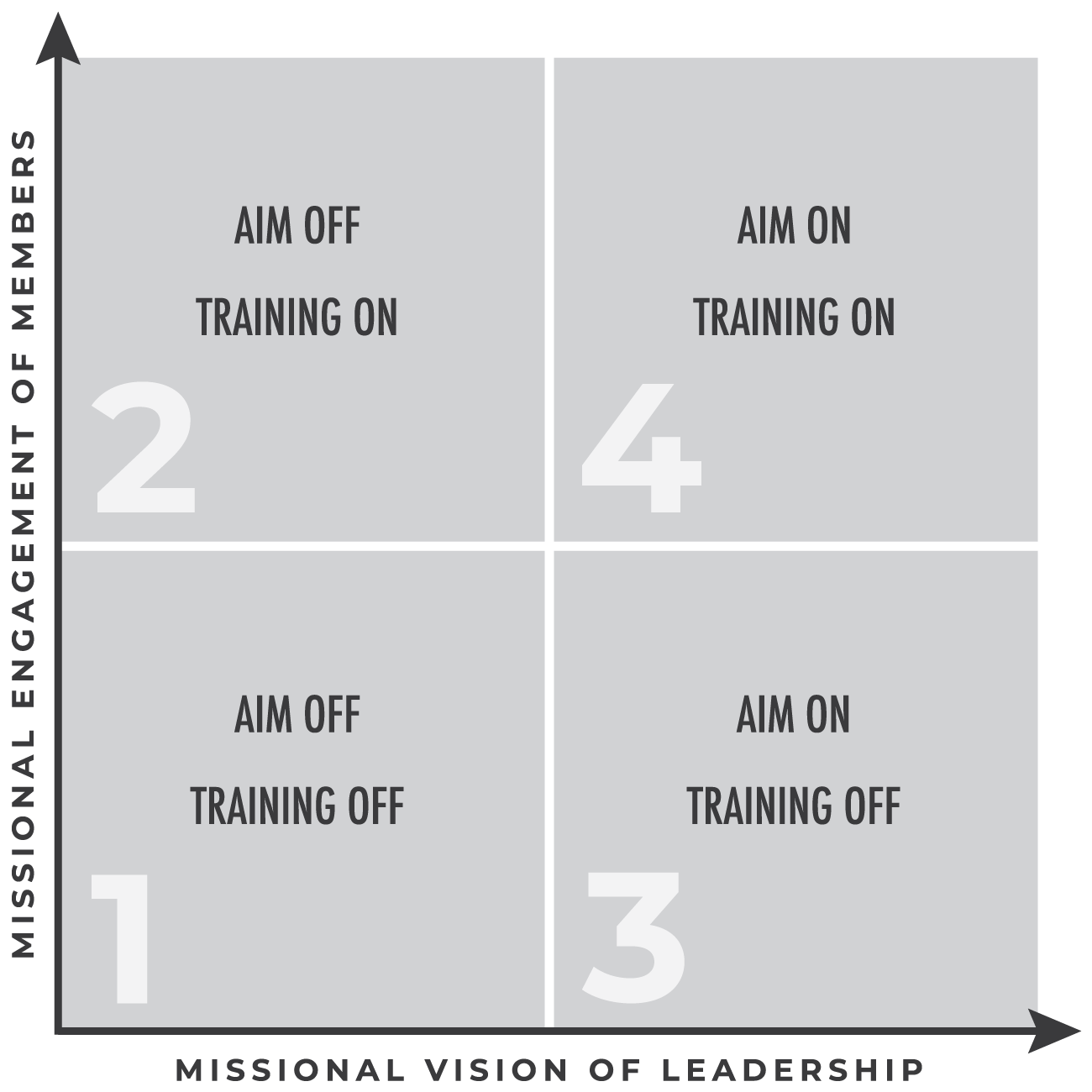
This is an interesting graphic to ponder. (A fully developed piece on leader dynamics is forthcoming.)
The most striking quadrant, in my opinion, is #2.
There, you do not have missional discipleship vision at the top, but there is still activity in the missional direction.
What is going on there?
It is the scenario where the pastor lacks the vision for the member’s mission, but others see its ultimate importance and are working underneath to try to push the church outward.
A Picture of Bold, Disruptive Leadership
(Excerpt from Game of Pulpits)
I close this observation with an excerpt from my new book, Game of Pulpits. It comes from the life story of Medical Director Eric Manheimer, depicted as Dr. Goodwin:
From the opening scene of Dr. Goodwin firing the entire cardio department for gouging patients with exorbitant costs, and his reoccurring line: “How can I help?,” what elevates the show is seeing the actions of a compassionate servant leader with unrelenting “find a way” tendencies. This innovative quality of rethinking/reinventing meets virtually everything he touches, and affects everyone around him. Dr. Helen Sharpe, Max’s deputy assistant is forced to take over and fill his shoes one day, makes a few bold decisions and direct challenges to the medical staff, at the end of the day thanks him for what he does routinely. “I got a taste of what you do in turning this hospital on its head, and I loved it!”
Watching the depiction of the real-life character, I found myself asking: How much are we resigning ourselves to our stuck church/ministry/missions situations? I’ll confess that’s me, way too often. I get stuck in my routine and rationalizations—those darn ruts! But there is something admirable in anyone who refuses to accept normalizing unfavorable, ungodly outcomes and bureaucratic gridlock. It takes guts not to cower to perceived limitations or continue the mediocrity of low expectations. It is a bold, determined leader who is willing to shake things up, rise above protocol, bend rules of traditions when necessary, and turn regularized practices on their head if it means fulfilling the mission.
Rephrasing the doctor’s driving question: How is it that people in desperate need of what we possess do not avail themselves of what we freely offer? It’s a compelling thought for any spiritual organizational leader who has something vital to bring to human lives. No other entity fits that bill, in my mind, with such depth of life-giving impact and living hope than Christ’s church. In our current state of affairs, how much more do we need pastors and staff who are turning the church on its head to fulfill its mission?
Final Challenge
Let me ask forthrightly:
Is that you?
Are you the kind of leader who:
- Refuses to let leadership potential in the church go untapped
- Invites others into meaningful contribution and co-creation
- Challenges entrenched systems when they hinder mission
- Equips people not just for activity—but for gospel influence
Because the church does not need more controlled environments.
It needs courageous leaders who unlock the leadership potential already in the room.
And right now—
That kind of leadership is not optional. It is essential.
Take the Next Step
If you are a top-level leader who wants to raise the game of your church—and would value sounding out ideas within your unique ministry context—
I invite you to connect directly.
If you would benefit from a focused conversation around your leadership dynamics, discipleship strategy, or mission direction, you can schedule a Zoom appointment here:

Be The First To Comment