

When I arrived at Talbot, I proposed renaming the evangelism course to include disciple-making strategies. That change was approved, and in the course I now dedicate an entire three-hour session to discipling new believers.
Over the past six years, one consistent observation has surfaced through student interaction: many churches—especially smaller ones, though not exclusively—do not have a specialized ministry for new believers. The reasoning, as students often explain, is simple:
“We don’t have enough of them.”
That logic is deeply concerning.
A lack of new believers points to evangelistic inefficacy, regardless of church size. It creates a lopsided congregation, missing key elements of spiritual health. This reveals how interconnected our ministries truly are. When evangelism is weak and new believers are not discipled, the outward movement of the gospel is hindered.
Some leaders may see this issue as low priority. They assume discipleship is already happening through the weekly gathering and the pastor’s teaching ministry. While that central teaching role is vital, it is not sufficient on its own.
Jesus’ command to make disciples requires more. It calls us to intentionally address the unique needs of new believers and to recognize their strategic role in gospel expansion.
The problem is not just the absence of programs—it is a failure to see how strategic this ministry truly is.
Why Ministry to New Believers Is Essential for Church Health
Grounding people in their faith is essential to the growth of the Church. New believers require intentional guidance in developing spiritual rhythms, practices, and understanding.
Reaching people and discipling them are related but distinct callings, each requiring focused attention.
When we place Jesus’ Great Commission—“Go and make disciples of all nations, teaching them to obey everything I have commanded you”—next to what is happening in many churches, the imbalance becomes clear.
Based on what I’ve heard, many congregations function something like this:
95% — Teaching existing believers
5% — Reaching and discipling new believers
In some cases, the gap may be even wider.
The Great Commission is first a call to reach the unreached. As we prioritize mission, we extend God’s love into our communities and multiply worshipers of Christ. This happens through the gospel.
A Healthy Church Framework for Ministry to New Believers
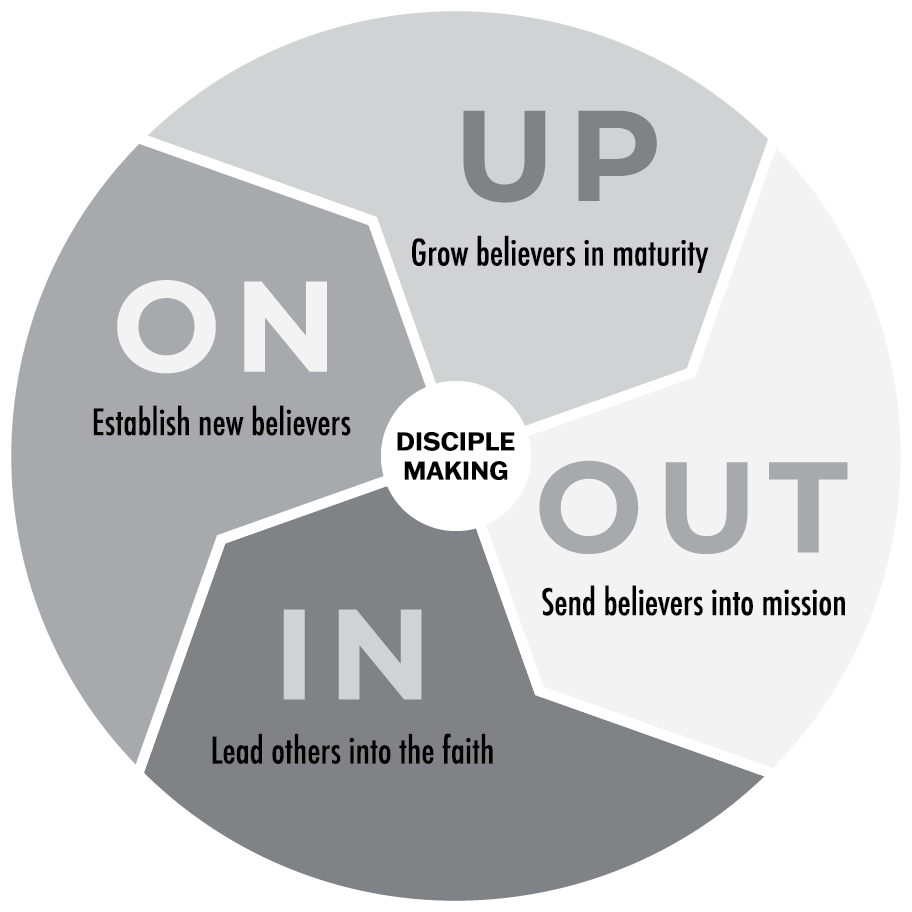
Healthy churches intentionally invest across four key ministry areas:
IN — Leading people to faith
ON — Establishing new believers on a discipleship path
UP — Growing believers in faith and mission
OUT — Equipping believers to engage their community and the world
This framework means that a significant portion of ministry attention must be devoted to IN and ON—the front end of disciple-making. When we mobilize people in these areas, we are actively obeying Christ’s command to make disciples.
From a missional perspective, the impact is profound.
When churches both reach new people and intentionally disciple them in their early stages of faith, the result is exponential influence.
Why?
Because new believers often have something many long-time Christians do not: close relationships with people who are not yet following Jesus.

A Real-World Example of Foundational Discipleship Impact
I saw this firsthand while serving on staff at Sandals Church in Riverside, California.
At one point, our typical baptism numbers—around 40—grew to 200. Part of that increase came through a class called First Steps Discipleship Training, where we grounded new believers in their faith and equipped them to share the gospel.
On the day we baptized 200 people, many of those individuals had come to faith through the influence of newly discipled believers.
The stories were powerful and unmistakable:
When new believers are equipped early, they become effective ambassadors for Christ.
Do You See Your Church Through These Four Categories?
For church leaders, this raises an important question:
Do you see your congregation through these four categories?
Every time you stand before your people, they are all represented:
- Those not yet in the faith
- Those new to the faith
- Those growing in maturity
- Those ready to be sent
Each group has distinct needs. Wise leadership develops clear pathways to move people forward from where they are—maximizing growth and gospel impact at every stage.
A ministry that is too generalized—one that fails to recognize the unique needs of non-believers and new believers—will inevitably weaken the church’s outreach.
Even Small Churches Can Build Effective Ministry to New Believers
But there is hope.
Even smaller churches can make meaningful changes with intentional training and focus.
If we are serious about fulfilling Jesus’ commission, we must devote significant attention to the beginning stages of faith.
Evangelistic disciple-making is the lifeblood of a healthy church.
And as we strengthen that foundation, we must also continue raising the bar for mature believers—calling them into deeper service and greater mission.
But that begins by getting the front end right.
Resources for Building Ministry to New Believers
First Steps Discipleship Training: Turning Newer Believers into Missional Disciples
(Wipf & Stock, 2014)
ReMission: Rethinking How Church Leaders Create Movement
(Whitaker House, 2018)

Be The First To Comment